

The Parisian gallery “LE SALON H” holds a photography exhibition of the artist Lara Micheli, who lives and creates in the French Basque Country
The Parisian gallery “LE SALON H” holds a photography exhibition of the artist Lara Micheli, who lives and creates in the French Basque Country

When Lara informed me that she wanted to title her personal exhibition with the enigmatic name of Extrasystoles, I was perplexed. After having imagined the reference to a punk group as mythical as it is confidential, thought of the name of an amphetamine or an acid, I had to admit my ignorance. And then what relationship with the photographs that we had chosen together and which, far from bearing the trace of nocturnal excesses, or the expression of psychedelic experiences, celebrated an apparently perfect family happiness? I asked Lara to enlighten me, which she did by sending me the following explanations by email:
« This complicated word designates a rather banal thing: a kind of blow in the chest caused by a double heartbeat, after a pause that is too long. We do not die of it, but the sensation surprises. Waiting for a beat that doesn’t come is a curious experience I had one summer. For no apparent reason, when the sun was shining and life was sweet; I did not see what could cause this cardiac intermittence. The fear that everything could end precisely at this moment of quiet happiness? Since everything depends on a heartbeat… This stuttering perhaps revealed deeper anxieties, resurfacing from the past. This series of Polaroid images illustrates the questions that crossed my mind at that time and still do today; a desire to contemplate and grasp life between two accelerations of the pulse. »
It is therefore through the filter of this (cardiac) anomaly that we must look at Lara’s photographs, and feel what they reveal to us. Taken with a Polaroid, these images, which take part in the long tradition of family photography, seem to decline snapshots of happiness. We see the artist, her children, her partner; the family reduced to its nuclear expression.
The golden light, the overexposures, the blurred contours, the cast shadows, reinforce this elegiac feeling of suspended time. The photographer’s deep love for her subject is palpable and yet distanced from reality. Lara Micheli perfectly masters the constraints and possibilities offered by her SX-70 camera. Constraints of light or framing, constraints linked to the impossibility of retouching the images, but also the ability to establish an intimate complicity with the model, and to trap the viewer in a state of timeless melancholy. Once the image has been taken, she will scan it and make prints on a scale that seems fair to her, keeping the imperfections.
But where does the feeling of growing tension come from, the worry that gradually spreads? Certainly from the fact that these images are not only the aesthetic expression from a moment of personal happiness (of a woman, a wife, a fulfilled mother) but also the highlighting of a universal concern.
Each of the photographs in the exhibition leads to a suspension, evokes an absence, and puts the viewer in a state of apnea. Looking at these photographs, one is led to physically experience this excessively long pause between two heartbeats, and this dazzling feeling that everything can be taken away from us.
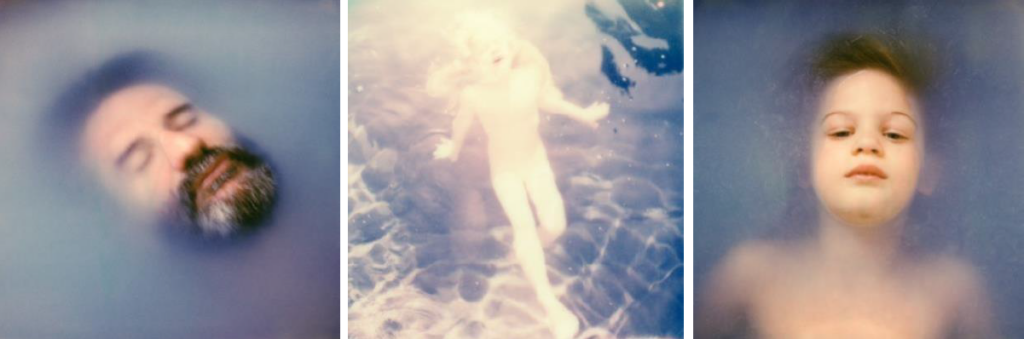
The triptych «Portrait bleu» is certainly the work that most literally illustrates this state. We discover portraits of man and child. Their bodies are clearly submerged, and only their faces, grasped by the lens, are flush with the surface of the murky water. Man has his eyes closed with a deep sleep; the child seems to challenge us with his gaze that pierces us. These two photographs frame the body of an open-mouthed child, floating in unreal and burned light for a second suspended.
There is, of course, a mystical dimension to this triptych and one cannot help but think about the use of water in Bill Viola’s work. We can guess Christian references to baptism, death, and redemption. We feel especially the brutal pain that can cross us at the thought of losing those we love. But by dint of dreading the moment of tipping over, there is a risk of precipitating the inevitable, in order perhaps to put an end to this unbearable expectation?
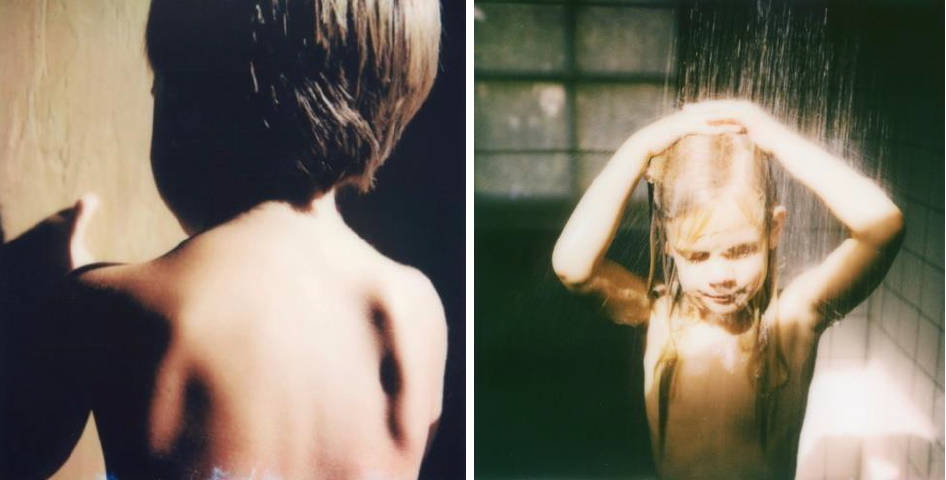
It is a similar ambiguity that makes us wonder about the meaning of the two photographs entitled « Premier Soleil ». These two portraits of the artist’s children are seen as the elegy of an early spring, a promise of renewal, a tribute to childhood.
But elegy means etymologically «song of death». So the boy turns his back on us, and the girl seems to protect herself from an acid light rain.
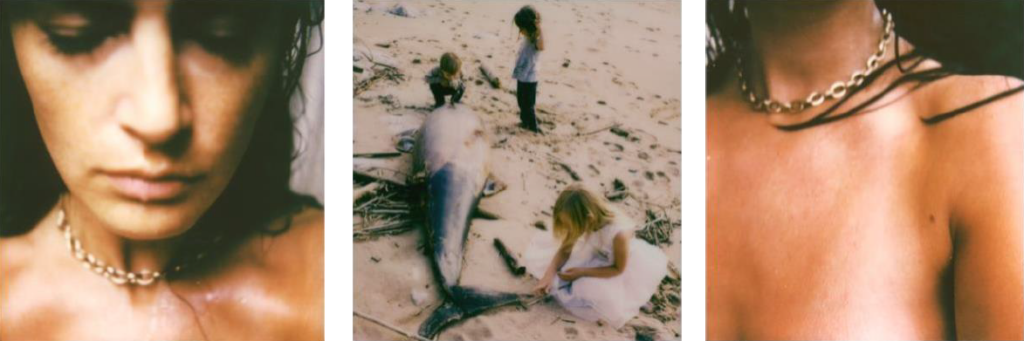
More clearly, death is staged in the series «Omnia Vanitas» where pieces of naked bodies are presented in counterpoint to photographs of children playing on the beach. Upon closer examination, the spectator discovers that the game consists in curiously working around the decomposing corpse of a dolphin stranded on the sand, and touching death with a finger. By contamination, the body yet radiant with youth knows itself irremediably condemned.
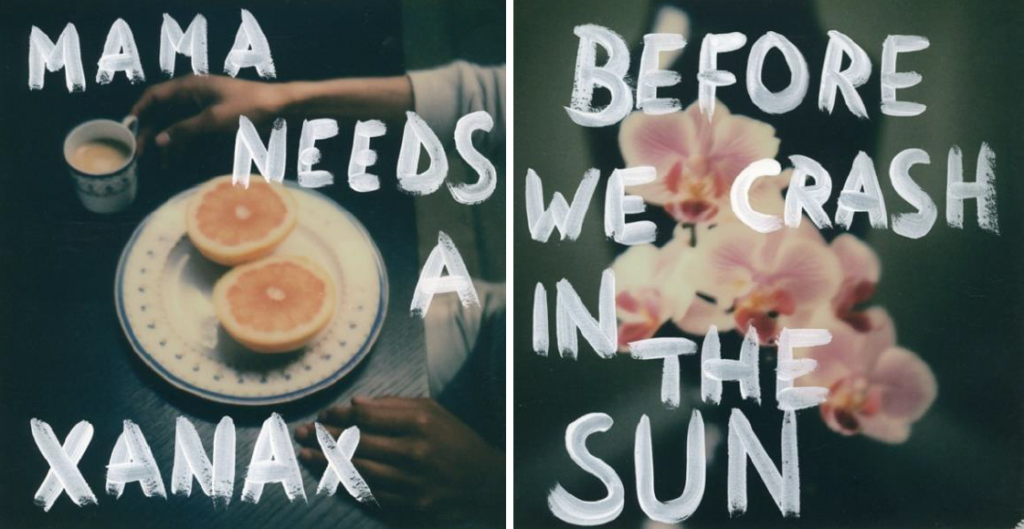
There is an urgent need to take advantage of the time that is given to us, or rather to seize the time that we have left, as the series «Post Scriptum» rightly points out. Here, anxious writing takes over the image of apparent banality of everyday life to superimpose a message like an SOS: «Mama needs a xanax» «Before we crash in the sun».
We quickly understand, the work of Lara Micheli goes well beyond the diary or the family portrait.
With modesty, the artist, both by his technical mastery and by the introspective force of his sensitivity, touches a form of metaphysical grace and approaches the work of the great photographer Sally Mann, whom she deeply admires. It should be remembered that Sally’s husband suffered from muscular dystrophy that affected his heart rhythm and inspired the photographer to the series Ponder Heart (2009).
To conclude, we would like to be able to tell Lara that her fight is not in vain, and that through her photographs she reminds us of this stanza from Ezra Pound’s Cantos:
« What you like remains
The rest is only ashes
What you like will not be taken away from you »
Philippe Zagouri
Director of LE SALON H


