Tal Tsfany: “Luxury is to be able to lead my life freely and autonomously toward a life of deep meaning, enjoyment, and unbreached self-esteem.”
Tal Tsfany: “Luxury is to be able to lead my life freely and autonomously toward a life of deep meaning, enjoyment, and unbreached self-esteem.”

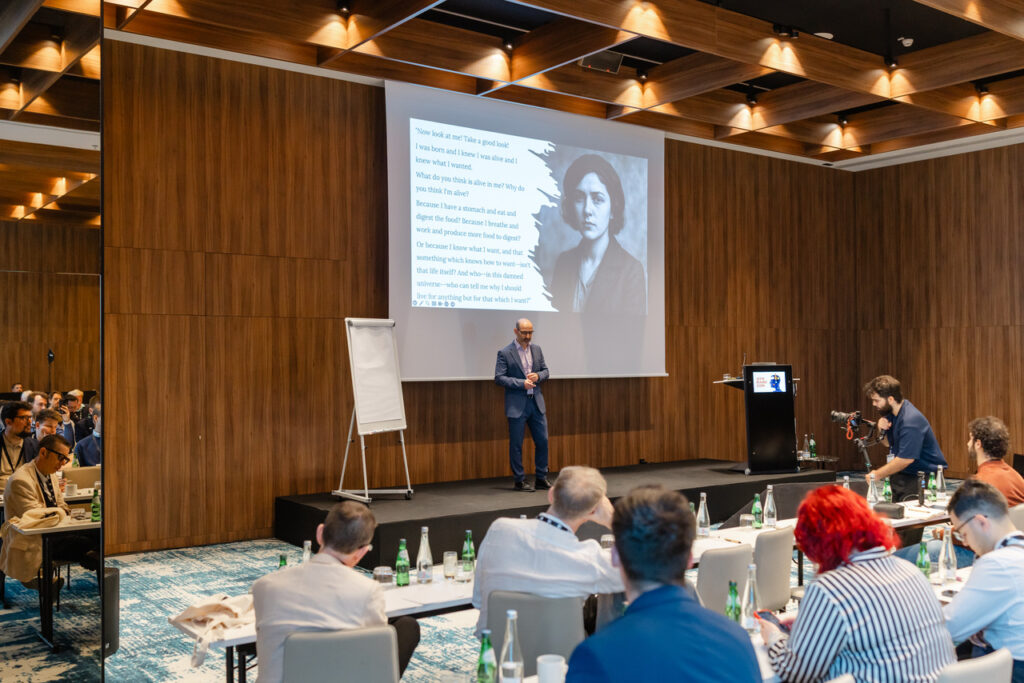
We traveled to Porto to attend AynRandCon Europe 2026 and interview Tal Tsfany, President and CEO of the Ayn Rand Institute (ARI), as the organization marks its 40thanniversary. ARI is a nonprofit dedicated to promoting Objectivism, the philosophical system developed by the Russian-American writer and philosopher Ayn Rand (1905–1982).
At the Porto conference, fundamental philosophical issues such as morality, reason, and faith were discussed, alongside current topics like the war in the Middle East. What responses does ARI offer to realities that did not exist in Ayn Rand’s time?
ARI is a home for many Objectivist intellectuals whose work is to teach, discuss, and apply Rand’s philosophy of Objectivism to many contemporary issues and current events.
No one can speak for Ayn Rand herself. She was a generational genius who gave us revolutionary new answers to perennial philosophical issues. Her philosophy, which she named “Objectivism,” is the proper name for her body of work. The Objectivist intellectuals at ARI do their best to understand the philosophy and offer their best interpretation that is consistent with Rand’s philosophy. Luckily, Rand herself wrote a lot about political and cultural issues of her time, which provides very clear perspectives on how she approached them. Those premises are what ARI’s intellectuals use to apply their analysis of current events.
One of the new initiatives presented at this conference was the Atlas Circle. What does this initiative consist of?
After finishing her Magnum Opus, “Atlas Shrugged”, Ayn Rand turned to write nonfiction. One of her first pieces was an essay called “For The New Intellectual,” which is a call to action for two audiences to come together and join forces rather than fight against each other–the intellectual and the businessman. Rand wrote in that article: “The New Intellectual will be a reunion of the twins who should never have been separated: the intellectual and the businessman. He can come from among the best–that is: the most rational–men who may still exist in both camps. In place of an involuntary Witch Doctor and a reluctant Attila, the reunion will produce two new types: the practical thinker and the philosophical businessman.”
Rand was pointing to a phenomenon in which businessmen were detaching from moral and political principles and intellectuals were becoming “ivory-tower,” detached academics. As in any other realm, here, the two professionals needed each other as part of the division of labor. The producers need the intellectuals to guide them toward the right principles, and the intellectuals need the producers for their material wealth creation and to help them connect to the complexity of reality.
Instead, those two types turned against each other, becoming the pragmatic businessman and the rationalistic, detached-from-reality intellectual.
The Atlas Circle is a program designed to bring together the best of both camps. To create environments for both intellectual professionals and professional intellectuals to engage, discuss ideas, and learn from each other. If we hope for a real cultural change, it will come from a critical mass of those two audiences pushing new, life-serving ideas that I believe Ayn Rand offers us.
To learn more about the Atlas Circle, you can visit AtlasCircle.org and read more about our initiative and the articles we’re writing for intellectual professionals.
What are the main conclusions you have drawn from the Porto conference?
I have drawn several conclusions:
First, we’re learning that interest in Ayn Rand and her philosophy of Objectivism is on the rise, and many young, intellectual minds are drawn to the powerful, highly integrated system of ideas she puts forward. We’re seeing growing numbers of participants at our conferences who are motivated to engage with the ideas seriously.
Secondly, we’re learning that the vision of pursuing an intellectual career is not very common among young people in Europe, and that we have to offer a vision for intellectual individuals who are passionate about ideas but don’t know they could pursue a fulfilling career that is both spiritually and financially rewarding.
Objectivism is a philosophy firmly established in the United States, but it still has significant room for growth in Europe. What are the core principles on which Objectivism is based?
I will quote Ayn Rand herself answering this question:
“At a sales conference at Random House, preceding the publication of Atlas Shrugged, one of the book salesmen asked me whether I could present the essence of my philosophy while standing on one foot. I did, as follows: Metaphysics: Objective Reality, Epistemology: Reason, Ethics: Self-interest, Politics: Capitalism.
If you want this translated into simple language, it would read:
- “Nature, to be commanded, must be obeyed” or “Wishing won’t make it so.”
- “You can’t eat your cake and have it, too.”
- “Man is an end in himself.”
- “Give me liberty or give me death.”
In your view, what are the most important philosophical challenges we face in the 21st century?
We are still suffering from the same core philosophical issue that Ayn Rand identified as the root cause of so much injustice and suffering: Altruism. In her book “Philosophy: Who Needs It?” Ayn Rand defines Altruism. “The basic principle of altruism is that man has no right to exist for his own sake, that service to others is the only justification of his existence, and that self-sacrifice is his highest moral duty, virtue and value.”
The idea that your life’s purpose and virtue is about serving others is the most destructive idea that is still prevalent in our society today, both on the political right (through thought religion) and left (through a secular version of the same religious idea).
“Atlas Shrugged” is Ayn Rand’s best-known work, but her corpus of essays and novels includes other key titles that contributed to the development of Objectivism. What does each of them contribute to the philosophical system she developed?
Ayn Rand dedicated several nonfiction books to the different realms of her philosophy. For her views on morality and ethics, you can read her book “The Virtue of Selfishness.” For her views on politics, you can read “Capitalism: The Unknown Ideal.” For her views on Epistemology, you can read “Introduction to Objectivist Epistemology.” For her view on Aesthetics, you can read “The Romantic Manifesto.”
Ayn Rand published several other books, which are collections of essays about different philosophical topics. I would especially recommend “Philosophy: Who Needs It?” “For The New Intellectual,” and “Return of The Primitive.”
Upcoming events organized by ARI include OCON (Objectivist Conference), which will take place in New Orleans from June 26 to 30, and AynRandCon US, to be held from September 11 to 13 in Austin. What can attendees expect from these conferences?
OCON is our annual conference featuring captivating lectures by leading Objectivist speakers. The conference is also an opportunity to meet many Objectivists and Ayn Rand fans from all over the world. We also host many social events, including the Ayn Rand Institute Gala, music, a talent show, and an annual poker tournament. For me personally, coming to my first OCON event was a life-changing experience. I met many like-minded people who became lifelong friends and colleagues. I highly recommend taking the time to register for OCON for anyone who is intrigued by Ayn Rand’s ideas. You’ll find professional speakers and intellectuals who you can learn so much from.
The Ayn Rand Conference in Austin in September is geared to young students who are beginning their journey with Ayn Rand’s body of work and are interested in deepening their understanding of Objectivism. Students are welcome to apply for scholarships for this conference, and adults are welcome to join if they are beginning their journey with Objectivism.
This year marks the 40th anniversary of the founding of the Ayn Rand Institute. How would you assess its evolution and impact over these four decades?
That is a question I’ve dealt with for several years, and my 2025 OCON talk was dedicated to my view on it. ARI has achieved tremendous progress in its mission to promote and propagate Rand’s philosophy of Objectivism. We have many successful programs at 3 levels: Awareness of Ayn Rand and her work, Understanding of Objectivism, and Intellectual Development for people committed to that philosophy and to an intellectual career in it.
For example, we have world-leading essay contests about Rand’s novels that have been running for 40 years. We announced at the Porto conference that we are upgrading the Atlas Shrugged contest to the “Atlas Prize,” which will award the winner aged 16-22 a first prize of $100,000 (!). I urge any intelligent, intellectual, serious student to participate in this program. It could be a life-changing event for them.
Also, ARI has managed to bring Ayn Rand and Objectivism to the cultural mainstream, to the point where every serious intellectual is expected to know “Who is John Galt?” and to understand Rand’s point of view. Objectivism is becoming a real alternative to the false alternatives of the mystical political right and the subjective left.
ARI is building a new campus in Austin, Texas, the Ayn Rand Center. It will be a home for the Ayn Rand University campus, which is in the process of obtaining accreditation. It will also be the home of the Ayn Rand Archives and a new project we are working on – the Ayn Rand Experience.
In 2028, the Ayn Rand Institute will be accredited as a university. What will be the academic offering of Ayn Rand University?
We will start by offering a Master’s degree in Objectivist Studies. It is designed for anyone who wants to dive deeper into Rand’s system of philosophy and to be able to compare it with other schools of thought.
Also in 2028, the new campus of the Ayn Rand Institute will open in Austin. What will this new complex offer to students, researchers, intellectuals, and academics?
The Ayn Rand Center is designed to be a global center of gravity for Objectivism. It will be a hub for anyone who is interested in Ayn Rand’s art and ideas. From students and adults who are not familiar with Ayn Rand and want to get a proper introduction to her work, to fans, to professional intellectuals. The center will have spaces and programs designed to allow for ideological conversation and exploration. It will have a salon dedicated to open conversations about life’s big questions: Is there a God? What does it mean to live a good life? What is a just society? What is the proper role of art? And so on.
We will have intellectual seminars, lectures, and debates, and we will also invite other academics to engage with our exclusive archival resources.
We are very excited about this historic milestone for Ayn Rand’s legacy and for ARI. We believe that this will be another step in mainstreaming Objectivism into the culture, which can hopefully shorten the time between now and the day when Rand’s ideas are prominent in the culture and guiding more individual and political decisions toward a better, more prosperous future.

You recently published the book “Secrets of a Passionate Life: A Thinker’s Guide to Profound Happiness”. How did this project come about?
My book “Secrets of a Passionate Life” is a culmination of a decade and a half of my engagement with Rand’s ideas. Since reading “Atlas Shrugged” and “The Fountainhead” for the first time, I’ve drawn on Rand’s inspiration and ideas to elevate my life to one of deep meaning and expression. I’ve reverse-engineered the process I’ve taken, with all the learnings, successes, and failures, the progress and setbacks, and compiled them into a short, concise set of principles. Those principles can guide anyone searching for more meaning in their lives.
I’ve tried to make this book as short and straightforward as possible, not requiring previous knowledge of Objectivism. It is a collection of 14 “secrets,” which are actionable principles, techniques, and exercises that can guide you toward deeper self-knowledge and value pursuits that will result in a state of genuine happiness.
To summarize it, the book helps the reader answer 4 main questions:
- Who am I? (which is also the question, what do I love?)
- How do I want?
- How do I get it?
- How do I enjoy it?
The book is also accompanied by a workshop I offer called “The Happiness Team,” which allows anyone to put those ideas into practice with the help of an accountability team of people who are going through the same process.
You can find more info about the workshop and links to my podcasts, “The Happiest Man Alive” and “The Unhappy Millionaire,” at TalTsfany.com.
We end all our interviews with the same question: What is luxury to you?
Luxury is to be able to lead my life freely and autonomously toward a life of deep meaning, enjoyment, and unbreached self-esteem. To enjoy my accomplishments spiritually and materially and live my life to its fullest.