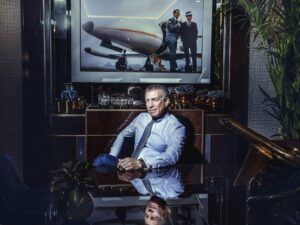
Luis Chillida: “For my father, luxury was having worked his entire life doing what he liked most.”
Luis Chillida: “For my father, luxury was having worked his entire life doing what he liked most.”

On the occasion of the centenary of the birth of Eduardo Chillida, BASQUE LUXURY is interviewing Luis Chillida, son of the sculptor and president of the Eduardo Chillida and Pilar Belzunce Foundation, the entity in charge of the study and dissemination of the work, thought, and figure of the most universal Basque artist.
In 2024 it will be 100 years since the birth of Eduardo Chillida. What events have been planned to commemorate this important date?
January 10, 2024 is the hundredth anniversary of our father’s birth, and we at the foundation are promoting that moment’s commemoration –a moment which is certainly important– and celebrating his life and what he did. We are considering a number of projects, but the centenary celebration has three main pillars: the exhibition of pieces of art at different museums and institutions; the dissemination of the thoughts of our aita (“father” in Basque) through conferences, discussions, and presentations; and, finally, there is the important facet of public works – works that are available to everyone here, in Germany, in the USA, and in other places around the world.
We have already made contact with many different national and international institutions –including institutions in the Basque Country– where there will be exhibitions. At some of those places, not everything will be just about aita’s work – his work and the context that surrounded him will be taken into account: at the Balenciaga Museum, the relationship between Balenciaga and Chillida will be discussed; we are also talking with Artium; at Chillida Leku we have the sculpture “Lugar de Encuentros IV” (“Meeting Place IV”) from the Bilbao Fine Arts Museum, etc.
Eduardo Chillida was born and lived most of his life in the Basque Country. What was his connection with this place like?
After the time he spent in Paris, which was three years at the very beginning of his career, he returned to the Basque Country and, in some way, got back in touch with himself. He always said that, thanks to having been away and having returned, he realized that this was his place, and from that time on he always lived here and worked here, although his work moved and traveled, but his home was here. Here, he focused on light, color, the “black light,” as he called it: “the black light of the Atlantic.” He said that we have a black light, even on sunny days. It is not Mediterranean light, which perhaps he saw in the Greek art at the Louvre when he was in Paris, as that art has a different type of light.
He is more attracted to this way of being and this place. He thought we all belong somewhere. My father was a person who felt quite rooted here. As he would say, “rooted like a tree;” he had his roots here, but his branches were open to the world.

The work of Eduardo Chillida cannot be understood without his wife, Pilar Belzunce. How did that duo work?
Theirs was certainly a special bond, because they were together all their lives from a very young age. In fact, they met when they were just 14 and 15 years old. I believe that there was a way of doing things between the two of them that had gradually been acquired over time.
My father was a person who did not at all like to mix two concepts that for him had nothing to do with each other: one was value –the value of work– and the other was price. For my father, the price of what things cost or what they were worth later was something that he didn’t want to think about and, logically, that was something that my mother dedicated her life to in order for my father to be able to make things. I remember that my aita always told us that without our mother he would have lived under a bridge, because he was a person who didn’t think about anything other than his art. She was that essential pillar on which my father relied to be able to get things done.
Chillida Leku is your father’s dream come true, a museum made like a great work of art in and of itself. Since 2019, it has had the support of the prestigious Hauser & Wirth Gallery, which has spaces dedicated to art in Hong Kong, the USA, the United Kingdom, Switzerland, Monaco, and Spain. What is the relationship like with the gallery regarding how Chillida Leku is managed?
For my father, Chillida Leku was a place; it was his place in the world. He often defined it as his own little Basque Country: it had its fields, it had its forest, it had the farmhouse, the apple trees, etc. Later, when my father began to get sick, that was when it opened to the public. And after some problems we had for a few years, in order to keep that legacy alive, we reached this agreement with Hauser & Wirth. It was really a great moment because we couldn’t have a better partner for a project of this type than the Hauser & Wirth Gallery and all the staff they have here, in Switzerland, in the USA, and in England. When all is said and done, it is a group of people with great expertise and a wonderful way of doing things, with whom we work in complete harmony.
We inherited the idea of Chillida Leku as a place, not as a museum; and now, through this relationship with Hauser & Wirth, we have realized that what we have is a museum and not just his workplace – and that implies a series of actions, a certain level of management that, thanks to the Hauser & Wirth team, is helping to give the museum a very significant boost.
Hauser & Wirth has also been the exclusive global representative of Eduardo Chillida’s legacy since 2017. How has this collaborative effort helped with the positioning of his art on the market?
Logically, everything helps. Having said that, one thing that my father has always had from the beginning is the fact that his work has always enjoyed very steady recognition and appreciation. He was not an artist with an enormous amount of production. Instead, what he did, he did well. He thought about things and he rethought about things.
The gallery has tremendous experience working with artists’ estates. When an artist goes away, his/her work does not go away. His/her work also does not continue; instead, it must be maintained, cared for, and pampered. Through this expertise that Hauser & Wirth has with legacies, the aforementioned is being achieved. This relationship is marvelous for both of us –for them and for us– and especially for our parents, who are the ones who started all this.

Eduardo Chillida’s work has a universal language and is present in public spaces and private and public institutions in the United States, Japan, Iran, Switzerland, Germany, Finland, Sweden, France, and Spain. Has his work been sufficiently recognized?
Yes, undoubtedly. My father was much better known internationally than nationally for more than half of his career. His exhibitions, his awards… everything came from abroad. Germany in particular was very important for him because of the special emphasis that my father’s relationship with German thought, with the German Romantics, and with German poetry had in his work. He often said that although he did not speak German, his work probably spoke German.
Many art critics, when they talk about my aita, highlight the respect and admiration he had from the rest of art world. In the 1950s, it was common to make a sculpture out of a mold and produce a series of 10 identical sculptures. Those 10 sculptures were considered unique pieces. When the gallery that represented my father at the time proposed doing series, he didn’t want to. Finally, in the year 1957, my mother convinced him and they did a small test to make four bronze copies of six original sculptures. The moment my father went to the Paris atelier and saw the original with the four copies, he said to my mother “Pili, this looks like a shoe factory,” and he told her that he would never do something like that again. “Am I going to copy myself?” he would say.
His gallery representative explained to him that not doing series was going to be very bad for getting his name out, because he was never going to have enough art. To which my father responded: “You’re telling me to multiply the art so that people can become familiar with my work, so that my art is in more museums and more collections; however, what I would like is to multiply the owners, not the pieces.” And multiplying the owners turned out to translate into public works. At that time, public sculpture consisted of Franco on his horse. There was no tradition of contemporary art in public spaces, and Chillida was one of the great pioneers to that end: he has almost 50 public works projects around the world.
What do you think was Eduardo Chillida’s great contribution to the Basque Country?
My father did not speak Basque well, although he knew how to name things, he knew the etymology. But he said that he had managed (thanks to the fact that he had given his graphic work names in Basque) to get practically all the museums in the world to have a Basque dictionary on hand to understand what the titles meant.
He was undoubtedly a person from here, from San Sebastián, and as a person from here, he also left his mark here with works such as “El Peine del Viento XV” (“The Comb of the Wind XV”), the piece in the Basilica of Saint Mary, the one in the San Vicente Church, the one dedicated to Rafael Balerdi at Pico del Loro, and, finally, this place… Chillida Leku.
What was luxury for Eduardo Chillida? And what is it for you?
For my father, luxury was having worked his entire life doing what he liked most. He was not a man who thought about other types of luxuries.
And in my case, I believe that the greatest luxury has been having met him, not only as a son, but having been with him for many years of my life, learning to respect, care for, and value what he did. And working in that context is undoubtedly a luxury.
Photographs: 1 Iñaki Luis (Luznorte Films), 2 Alejandro Braña, 3 Unknown.