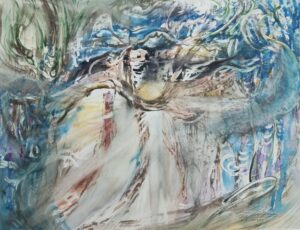
Jesus Mari Lazkano: the artist presents his personal take on nature in “The Last Ice”
Jesus Mari Lazkano: the artist presents his personal take on nature in “The Last Ice”

In an incomparable setting inside the Urdaibai Biosphere Reserve lies the studio of Jesus Mari Lazkano, one of the most prominent contemporary artists on the Basque cultural scene. In this spacious studio with clean architectural lines, one can find the fiction of a natural world captured with great realism on enormous canvases. “The Last Ice,” the artist’s name for this collection of work, presents his unique take on nature, placing us face to face with ourselves, making us question our own way of approaching nature, exposing our utilitarian vision towards the natural environment. His paintings depict landscapes, realities, and our environment as being on the verge of collapse, spaces of radical transformation; a future scenario that will definitely cease to be like today if we fail to seek remedies.
These are fragmentary narratives that leave us breathless, aware of a certain inevitable disappearance, like spectators of a monumental shift that brings about uncertainty, mixed with the beauty of the places and the pleasure of contemplating them. A tense balance between the order of what we know and the impossibility of understanding; contradictory interpretations, pleasure and fear versus the beauty of the sublime and the inevitable attraction of the abyss.
Just as in the works of Caspar David Friedrich, who was said to have discovered the “tragic landscape,” Lazkano’s point of view is not a complacent, pleasant, or bucolic one, but rather his perspective is based on a profound search for the sublime; a pictorial approach to the natural fact. Through his work, he investigates the superhuman aspect of the landscape, its impossibility; our inability to understand natural phenomena, reach them, much less control them.
From an artistic standpoint, “The Last Ice” is part of the debate on the sustainability of our actions as they pertain to the environment and the physical reality that we humans are transforming. This debate can be raised at an exclusively scientific, political, or social level, but in a more global sense, communicational, visual, and emotional aspects are usually left on the back burner. We know the facts of our reality, but we need an emotional provocation to get us involved. Art can fulfill that function and, by fostering sensitive connections, give rise to awareness and get the message into our collective mind. Every paradigm shift comes with a visual corpus to accompany the conceptual and cultural change. This exhibition offers a visual stage around which we can debate.
The canvases in his studio –which is well worth a visit– are intermixed with storyboards and pastel drawings hung on the walls from the animated short film “Natura Fugit,” which he is currently working on. The film represents a different medium, but it shares the same message as his paintings: a vindication of what we are losing, of what is leaving us, of the last ice.
Jesus Mari Lazkano
Tel.: +34 655 713 628