Chillida Leku: the museum dedicated to the artist Eduardo Chillida is turning 25 years old
Chillida Leku: the museum dedicated to the artist Eduardo Chillida is turning 25 years old

The year 2024 marked 100 years since the birth of Eduardo Chillida, the most internationally renowned Basque artist. The activities to commemorate the occasion, which began in 2023 and will run until the end of 2025, include, among others: the publication of the memoirs “They Lived for Art: My Parents, Eduardo Chillida and Pilar Belzunce” by Susana Chillida and the graphic novel “The map of Chillida” by David Marto; the premiere of the documentary “A Hundred Birds in the Sky” by Arantxa Aguirre; exhibitions organized in museums and exhibition spaces on a national level (San Telmo Museum, Tabakalera, Cristóbal Balenciaga Museum, Lenbur Territory Museum, Bilbao Fine Arts Museum, and Hauser & Wirth Menorca) and international level (Würth Museum of Künzelsau and the Pontifical Catholic University of Chile, among others); likewise, the creation of a Real Sociedad de Fútbol shirt (Eduardo Chillida was the team’s starting goalkeeper between 1942 and 1943) which includes a reproduction of the artist’s piece entitled “Abiagune II.”
Many of these commemorative initiatives take place at Chillida Leku, a site founded by Eduardo Chillida 25 years ago now, where the largest and most representative body of work by the artist can be found. It is located on the outskirts of Hernani, very close to San Sebastián, and is made up of an open-air set of sculptures and an exhibition space inside the Zabalaga Estate, a traditional Basque farmhouse erected in the sixteenth century.
The house and its adjacent grounds were acquired in the 1980s by Eduardo Chillida and his wife Pilar Belzunce, who personally restored and refurbished them over the course of more than fifteen years. That first rehabilitation project was carried out in close collaboration with the Basque architect Joaquín Montero, who helped the couple’s highly personal vision for the exhibition space to materialize. The sculptor was looking for a home for his artwork –a “place” (in Basque, leku)– where future generations could learn about and experience his art in a unique setting. Once the renovation work that brought the farmhouse back to life was completed, the museum opened to the public on September 16, 2000.
In 2019, the museum embarked upon a new chapter with the support of the prestigious Hauser & Wirth Gallery of Switzerland (which has spaces dedicated to art in Hong Kong, the USA, the United Kingdom, Switzerland, Monaco, France, and Spain), featuring a remodel directed by the Argentine architect Luis Laplace, known for his respectful and sustainable interior design and restoration work developed in close connection with art. In addition, Laplace worked closely with architect Jon Essery Chillida, the sculptor’s grandson.
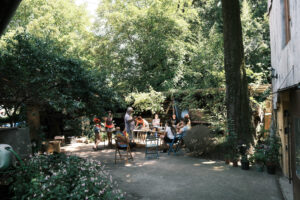
Thanks to the good general condition of the facilities, a total remodel was not necessary. Instead, a respectful update was carried out, always striving to uphold Chillida’s vision for his museum. The farmhouse –the museum’s main building– maintains exactly the same appearance and structure that Chillida conceived. In addition to the improvements, some new facilities were launched like a welcome center for visitors, the Lurra café, and a shop. The project also had the contribution of Dutch landscape artist Piet Oudolf, a pioneer of the New Perennial Movement who introduced subtle landscaping elements.
Currently, the museum acts as the stage for numerous cultural and educational activities that are closely linked to the local community. It also hosts guest artwork by great creators and organizes temporary exhibitions featuring renowned artists whose pieces are related with the figure and legacy of Eduardo Chillida. This year, as Chillida Leku is celebrating a quarter of a century, a visit to the museum really is essential, and the exhibition program promises to be second to none.
Chillida Leku
Barrio Jauregui 66, Hernani.