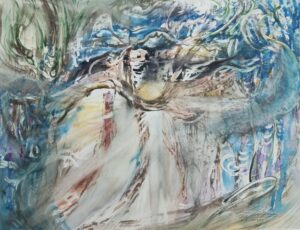
Alfredo Bikondoa: we visited the studio of the artist who connects with the souls of people and transfers them from the spiritual plane to the material plane
Alfredo Bikondoa: we visited the studio of the artist who connects with the souls of people and transfers them from the spiritual plane to the material plane

Is Alfredo Bikondoa an artist? That label (we humans have a natural tendency to label everything) doesn’t do him justice. Bikondoa transcends the limits of the artist who takes reality and transforms it into an activator of emotions. Bikondoa is part of a very small list of chosen ones who can see beyond reality. A man who can see where others can’t see. Who can feel what others don’t feel. Who can even love what he doesn’t understand and turn it into art. That is Bikondoa. So simple, so complex, so abstract.
It would be easy –too easy– to list the many words of praise that have been written, said, and heard about the artist and his work. Even so, we must take into account the esteemed Alfonso de la Torre, a great theorist and art critic, who once said: “For Bikondoa, ‘seeing’ means distancing oneself from the object and ‘portraying’ above all else, ignoring the surface of things, generating a tension that frequents our creative time. That is, the result of a blind dialog that anchors its roots in the well-known debate between identity and alterity” (“Alfredo Bikondoa: Un retrato de la nada,” 2010).
In less scholarly but equally true words, Bikondoa connects with the souls of people, of physical objects, of experiences, of his own experiences, and transfers those souls from the spiritual plane to the material plane. There is no more pleasant experience than being an observer –without being observed– when he works in his studio (Casa del Este); concentrating, making a piece of art of colossal dimensions emerge from his hands with an ease that the rest of us mortals find astonishing. Bikondoa’s special connection with the astral world is, without a doubt, his hallmark. The stifling air of the Mojave Desert flows through his mind, forging a mystical knowledge in him that led him to become a Zen master. An apprenticeship lasting two decades that, while leaving him out of a generation of Basque artists, has allowed him to build a reputation as a sniper. A self-made man. Bikondoa is Bikondoa.
Alfredo Bikondoa, born in San Sebastián in 1942, is more important for what lies ahead than for what he leaves behind. There are artists who, having reached certain milestones, conclude that the sand in their artistic hourglass is slipping away to the last grain. They live off a memory that is much sweeter than a reality with dire overtones. That is definitely not the case for Bikondoa. His triumphs are many: he “faced” none other than Picasso himself in New York; he was acclaimed at the thirteenth edition of the Havana Biennial; he shook the foundations of the future at ARCO-VIP19; he was commissioned by the Vatican Information Service to create the 2005 Christmas card… but these victories are not constantly on his mind. Bikondoa lives for today and tomorrow. He assumes a quasi-subversive role, one which seems to be reserved only for the youth absent from social debate. Once again, acting as a sniper, he heads up an artistic discourse of denunciation that warns that the Mediterranean has become a graveyard. In one of his latest pieces, “The Graveyard by the Sea,” he mixes the human drama happening in the waters that Joan Manuel Serrat sang about and the literature of the universal Frenchman Paul Valéry.
Bikondoa goes even further still and shows us what “The Direct Path to the Truth” is. Once again, his work exposes us to the shame of a reality manipulated by power and turns his Bikonbotas (foot-shaped pieces made in cement) into ambassadors of a discourse that connects us with hope, part of a caustic and indomitable man, growing before the public when his voice and his words take over for his hands and for the materials with which he forges paths and truths that are irrefutable.
His steps will soon take him to the Antonio Pérez Foundation in Cuenca and he is awaited in various parts of Catalonia. He takes his career as new stages along the path of self-realization and permanent self-discovery that is his life. Thus, he has chosen to live by not only avoiding challenges but actively going out to seek them. He is so prolific and still has so much to do that he is now fully committed to creating his own foundation, to turning it into a tool for disseminating his work, and to fostering an international dialog that will take his legacy even further. Time does not exist.
Alfredo Bikondoa