Aitor Delgado: the guide who will show you the corners of the Basque Country frequented by Hemingway, Picasso, Woody Allen, John Adams, and Saint Ignatius of Loyola
Aitor Delgado: the guide who will show you the corners of the Basque Country frequented by Hemingway, Picasso, Woody Allen, John Adams, and Saint Ignatius of Loyola

There are many historical figures who were born, lived, or worked in the Basque Country. Ernest Hemingway, the Pulitzer Prize winner and Nobel Prize winner in Literature, is one of them. The landscape and culture of the region inspired the journalist to write some of his books, including “The Sun Also Rises,” the novel that takes place during the Running of the Bulls Festival in Pamplona. Following in the footsteps of this author and other figures, private guide Aitor Delgado has researched and prepared content so that clients can design their own personalized private tours of the Basque Country with him. Aitor invites visitors to learn about the stories and intricacies of the places frequented by great artists, couturiers, filmmakers, sailors, members of the clergy, musicians, and politicians.
Pablo Picasso is perhaps the most famous painter with ties to the Basque Country. He has rightfully earned merit from having made the atrocities of war visible through his painting “Guernica.” His time at the Real Club Náutico (“Royal Yacht Club”) of San Sebastián was immortalized thanks to a photograph taken with artist Jesús Olasagasti in 1936. He also had some Basque painter friends, and there are pieces by him and his friends in the region – as well as other revelations that visitors can learn about and enjoy alongside Aitor.
The list of film actors and directors who have been in the Basque Country is endless: Bette Davis, Al Pacino, Anthony Hopkins, Robert De Niro, Richard Gere, Meryl Streep, Julia Roberts, Steven Spielberg, Roman Polanski, Francis Ford Coppola, etc. Attendance at the San Sebastián International Film Festival is almost a must for any filmmaker. Some, like Woody Allen, have special importance in the region, as they have chosen it as the setting for a film. Aitor Delgado takes travelers to see the exact places where “Rifkin’s Festival” was filmed. Likewise, he tells anecdotes of libertine behavior like that of Ava Gardner, who skinny dipped on the island of Txatxarramendi, in Urdaibai.
This Basque cicerone also opens the doors of knowledge about Basques who have become prominent on the world stage. Some of these stories are very well known and others are little known, yet exciting and personal.
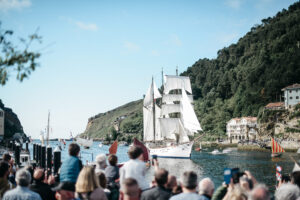
Cristóbal Balenciaga deserves special mention, as he was born, trained, worked, and opened his first business in the Basque Country. Today, there is a museum dedicated to his work, as well as there being numerous places that he frequented while living on the Basque coast before moving to Paris. Juan Sebastián Elcano, the first sailor to circumnavigate the globe, was from the same municipality as Balenciaga (Getaria). To delve deeper into his way of life, Aitor Delgado suggests combining a visit to Getaria with a trip to the sea on the Spirit sailboat.
Bilbao native Diego de Gardoqui was the Spanish ambassador to the United States during the term of George Washington, the first president of said nation. John Adams and John Quincy Adams, the second and sixth presidents of the United States respectively, also visited the Basque Country. Father and son were together in different municipalities of Biscay and Álava. “This extraordinary people have preserved their ancient language, genius, laws, government, and manners, without innovation, longer than any other nation of Europe,” stated John Adams in his book entitled “A Defense of the Constitutions of Government of the United States of America” (1787).
Saint Ignatius of Loyola and Saint Francis Xavier, founders of the Society of Jesus, are two other names that attract numerous believers to the Basque Country and Navarre. Their journey goes far beyond the Sanctuary of Loyola, and that is why it is important to have a specialized guide in order to uncover the details of their exciting lives. Another of the most controversial figures of the Spanish Golden Age is the explorer, soldier, nun, and memoirist Catalina de Erauso, who posed as a man under the name Alonso Díaz Ramírez de Guzmán.
The work of composer Sebastián Iradier, author of “La Paloma” (“The Dove”) –the most reinterpreted popular Spanish song– has made a fundamental contribution to the history of music. His habanera “El Arreglito” was included by Georges Bizet in his famous opera “Carmen.” On the guided tours, Aitor Delgado plays the two pieces to show the similarities between them and so that travelers can come to understand the lives of the players they admire (and of other unknown and exemplary others) with all five senses.
Aitor Delgado
Tel.: +34 687 476 134