Ricardo Ugarte: The Essentiality of the Sign as Aesthetic Navigation
Ricardo Ugarte: The Essentiality of the Sign as Aesthetic Navigation
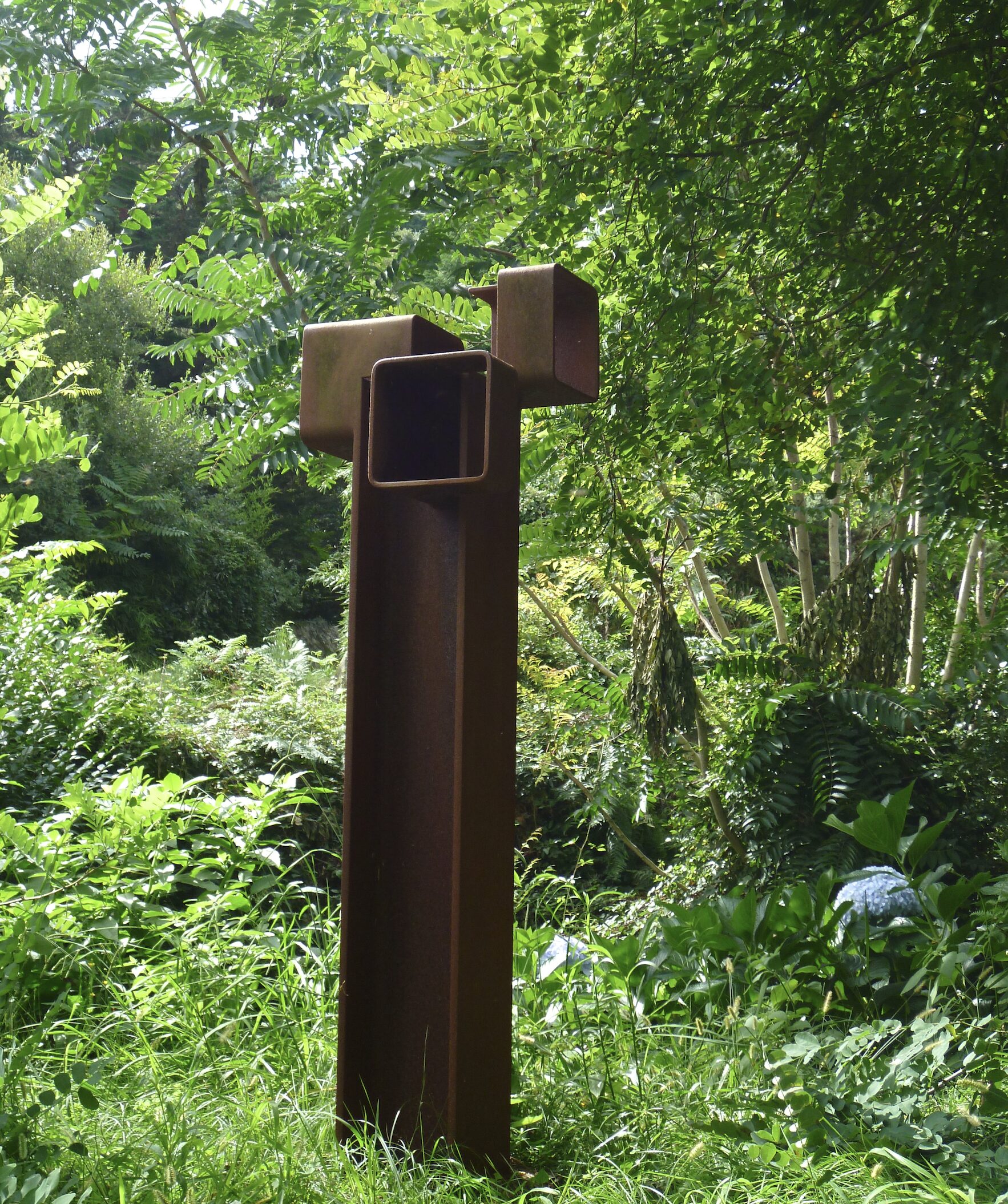
In the text entitled “The Essentiality of the Sign as Aesthetic Navigation,” poet and narrator Julia Otxoa described the work of sculptor Ricardo Ugarte as follows: “The sea as a rich allegorical universe has always been present in both the sculpture and graphic work of Ricardo Ugarte: mooring bollards, anchors, ships’ bows. A constant dialog with nature as a consciousness of existence in the world. The maritime realm as a transcended reflection of being and time; ships and the sea, matter, and iron as a material turned synthesis full of meaning, forming the links of a certain aesthetic navigation imbued with profound spirituality, with a feeling of time as something poetic. His conception of art as a unit comprised of all the manifestations of the universe resuscitates the romantic dimension of the historical avant-garde; the feeling of art as an attitude towards existence. Intellectual exploration is, at the same time, a philosophy of life, realized through a minimalist syntax that is resounding in formal conclusions in all the disciplines in which he works, be they sculpture, painting, engraving, photography, or literature. Each of his pieces seems to approach more and more a certain silencing of forms of expression, a quest for the utmost essentiality of the sign as an aesthetic inquiry. Stripped of any kind of formal rhetoric, his narrative (which is simultaneously conceptual, constructive, and lyrical in nature) creates spaces for contemplation, for meditation, for slowness as a depth of gaze, delving into the being of things. This attitude towards transcendence is unusual in the midst of a twenty-first century full of storms and whirlwinds of vanity. Lastly, the geometric austerity of his ship bows and the extreme delicacy of his graphic work’s subtleties clearly define the poetic architecture of his unanswered questions as a driving force and quest for utopia acting as the Milky Way and point of reference for guiding the labyrinth’s course.”
Considered to belong to the School of Basque Sculpture alongside Jorge Oteiza, Eduardo Chillida, Néstor Basterretxea, and Remigio Mendiburu, Ricardo Ugarte’s work overflows into graphic pieces, photography, visual poetry, and literature. His sculpture and graphic work is present, among other places, at the Reina Sofía National Museum Art Center of Madrid, at Artium Museum of Vitoria-Gasteiz, at the Andalusian Center for Contemporary Art of Seville, at San Telmo Museum of San Sebastián, as well as in a myriad of national and international public spaces in France, Germany, the USA, and Japan.
In relationship with the Toyama Art Triennial (Japan) held in 1990, art critic Vicente Aguilera Cerni explained the Basque sculptor’s work as follows: “Ugarte’s artistic career began in the late 1950s and is characterized by the plurality of his experience in various aesthetic fields. As for materials, he typically uses iron beams –industrial products– to create modular elements with absolute austerity and visual effectiveness. One must not forget his poetic evocation of the wings of a bird in flight. The direction of this artist trained in neo-constructivism is expressed through simple structures. His search for the elementary and primary makes him a vigorous exponent of the minimal experience, in which the most common elements of the industrialized world are used with radical clarity, creating objects for meditation; objects destined to become symbols.” Art historian Daniel Giralt-Miracle also links the beginnings of Ugarte’s sculpture work to the constructivist movement: “The rational base –linked to constructivism– that we find in his early work becomes, over the years, a vibration, a display of forms that can be identified with titles as suggestive as “Aleteo del espíritu” (“Fluttering of the Spirit”), “Aleteo del fuego” (“Fluttering of Fire”), “Cabello del viento” (“Hair of the Wind”), “Inicio de aleteo” (“Start of Fluttering”), etc. Immediately after that early phase, Ugarte dedicated his time to creating minimalist experiences in which he would dispense with all gesticulation to reach the most essential of the form through a construction that makes no concessions to rhetoric. His series that consecrates the beam –or the iron column built with a double T– is an obvious example. Constructive criteria based on the purest expression of orthogonality seek maximum formal bareness; these are primary structures, deliberately reductionist in nature, uplifted to the category of a monument with totemic vocation and a radical desire to form part of the landscape of our cities. Mysterious castles have emerged from these beams, directly linked to this austere rationality that combines emptiness with fullness –the wall and the window, the inside and the outside– in a precise and suggestive definition of volumes. Solid, resounding shapes that invite spectators to enter into poetic, uncharted spaces genuinely linked to the Basque tradition.”
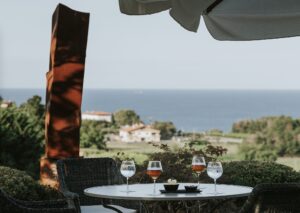
Following the Kantian philosophy of understanding space as a form of our sensory knowledge, we must speak of “Itxas Burni” (“Sea and Iron” in Basque) as the aesthetic space that best reflects and represents Ugarte’s work: it is a garden of trees and sculptures facing the sea, located on Mount Igueldo in San Sebastián and which can be visited by appointment. The sculptor, with the sensitivity of a naturalist aesthete, transformed barren land into a paradise of life and art. He did so by turning stones into birds. By designing the landscape as if he was drawing on a canvas; with the tree and plant species next to the sculptures. His relationship with the land is that of a sibling, interweaving paths and conceiving spaces for tranquility that come together in a dialog of peace and shelter for the spirit.
Ricardo Ugarte