Coast or dry land? An urban getaway or a rural break? This route by road will show you everything that the Basque Country has to offer
Coast or dry land? An urban getaway or a rural break? This route by road will show you everything that the Basque Country has to offer
This article suggests a route for visitors to discover the most attractive landscapes of the Basque Country. It is designed so that travelers can enjoy the complete range of offerings that the region has in store from the freedom and comfort of their own vehicle, or by public transportation. Discover cosmopolitan cities, fishing towns, and medieval villages. Start the trip with the scent of the sea breeze or by watching the morning fog fade away over a valley surrounded by mountains. Savor the renowned cuisine of the Basque Country in a restaurant at a fishing port, or watch from the terrace of your hotel room as the sun sets over a hill of vineyards. To make the trip more environmentally sustainable, the sections of the route are also fully prepared to be enjoyed by electric motorcycle or car. The route is divided into three sections, stretching from Lekeitio to Zarautz, from Vitoria-Gasteiz to Laguardia, and from Orduña to Bilbao, as we make our way through the three historical territories of the Basque Country.
Lekeitio – Zarautz
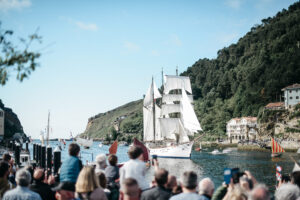
Lekeitio must be discovered from the Santa Catalina Lighthouse and by strolling through its alleyways lined with the colorful fishermen’s houses. We start out by following the BI-3438 highway along the rugged coast until reaching Ondarroa. With an old town protected by the monumental Santa María Church and the port, Ondarroa possesses a true curiosity of engineering: the Alfonso XIII Swing Bridge.
Following the GI-638 highway –and now in Gipuzkoa– we arrive to Mutriku, which made a living from whaling for centuries. The old town is medieval and features many steep slopes upwards and downwards. Taking the GI-638 highway eastward, we’ll cross the Deba River and link up with highway N-634. Following the river to its mouth, we reach Deba, a town that played a very important role in European trade. The Santa María Church has a polychrome portico and, inside, a Gothic cloister – the first to be built in Gipuzkoa.
We return to the N-634 highway towards San Sebastián to reach the rural neighborhood of Itziar and visit its Gothic sanctuary. To the south, route GI-3210 takes us to Lastur Valley, a hidden spot where a native breed of bulls is bred (and fought), the “Betizu.” Once past the Lastur quarry and Azkarate heights, we link up with route GI-2634 to Azkoitia, a picturesque and noble town. On the way to Azpeitia, we’ll visit the San Martín Hermitage, perched atop a hill with views of Izarraitz Crag. In Azpeitia, in addition to the basilica dedicated to Saint Ignatius of Loyola, we can visit the highly interesting Basque Railway Museum. We follow the River Urola to Zestoa, a town with ties to tourism centered around thermal waters. The Ekainberri Cave (a reproduction, open to the public, of the Ekain Cave) is considered a European sanctuary for cave paintings featuring animal figures that exude realism. In Zumaia we reach the sea again, as well as a unique landscape known as the Basque Coast Geopark. The Algorri Interpretation Center will tell us all about the geological phenomenon, but the only way to really experience it is to walk along it.
Route N-634 runs very close to the ocean – so close that as the sea swells, waves may caress the roadway. Getaria is famous for its fish roast houses. Zarautz has no port to boast of, but it can be proud of its beach, with surfers taking advantage of its waves so as to practice the sport they are passionate about. A lively boardwalk, a handful of mansions, the photography museum, and the Iñurritza Dunes (declared a protected biotope) round off the area’s vast offerings.
Vitoria-Gasteiz – Laguardia
Years ago, Vitoria-Gasteiz opted for a green future, constructing pedestrian streets, bike paths, and urban parks. It bet on green and won, managing to become a city with an enviable quality of life and an ideal size to be discovered on foot or by bicycle. The medieval Santa María Cathedral is its most emblematic monument. It is located in the heart of the old town, just a few steps from the famous Virgen Blanca Square and the Artium Museum.
We leave Vitoria-Gasteiz along route N-104 until passing Ilarratza and then take the A-3110 turn-off. We drive on roads parallel to the Way of Saint James, all of which feature numerous monuments linked to this ancient route – such as the Romanesque Sanctuary of Our Lady of Estíbaliz and, next thereto, the Romanesque Interpretation Center of Álava. At Elburgo, we will be surprised by the Romanesque San Juan de Arrarain Hermitage and at Alegría-Dulantzi, the lanky tower of the church awaits us. Upon passing Adana and Guereñu, we will connect with route A-4140 which –in seconds– will leave us at the gates of Alaitza. Its Asunción Church houses one of the few examples of Basque Gothic frescoes. History repeats itself in nearby Gazeo, whose medieval temple features striking Gothic frescoes – this time with biblical scenes.
Agurain/Salvatierra is the most monumental village on the Álava Plain and the one that best preserves the remains of the city walls that once protected it. On the map, the shape of Agurain/Salvatierra is reminiscent of that of Vitoria-Gasteiz: a medieval almond with only three parallel streets and numerous stately homes emblazoned with coats of arms. At either end, it houses two fortress-like churches: the Church of Santa María and the Church of San Juan, both integrated into the old city walls.
Along route A-2128 towards Opakua and then along route A-4112 towards Arriza, we will arrive at the Sorginetxe Dolmen, one of the great megalithic monuments of the Basque Country. Now we’ll set course for Opakua and climb one of the highest mountain passes in the Basque Country, with its enviable views. We descend to the Arana Valley and, by means of a leafy canyon, we reach Santa Cruz de Campezo and Antoñana, two markedly medieval towns.
Along the A-3136 highway towards Bernedo, accompanied by the rocky walls of the Sierra de Cantabria Mountain Range, Izki Natural Park is a little paradise worthy of a weekend’s stay. Kripan, Elvillar, with its famous “La Chabola de la Hechicera” Dolmen (“The Witch’s Hut”), El Campillar, and Lapuebla de Labarca, with its Baroque and Renaissance façades, are all towns we’ll pass through on the way to Elciego, where we’ll be surprised by an imposing titanium building which is situated alongside a Baroque church. We have reached the Rioja Alavesa region, with its sea of vineyards spreading out at the foot of the Sierra de Cantabria Mountain Range and with Laguardia as the capital.
Orduña – Bilbao
At the foot of the Sierra Salvada Mountain Range, Urduña-Orduña is a town with a protected old quarter. Routes A-625 and A-624 take us to Artziniega, another town declared a Historical Monumental Complex which looks like a film set. We retake route A-624 once again towards Balmaseda to discover the Las Encartaciones (or Enkarterri) area, a little-known territory of Biscay.
Balmaseda is its capital and it was the home of the La Encartada Beret Factory, which has now been converted into an industrial museum with a beret shop inside. The old part of the town is reached by means of a medieval bridge. After visiting the San Severino Church with its asymmetrical façade and beautiful Gothic windows, we take route BI-630 to enter the Karrantza Valley. The tourist office is in Ambasaguas and a couple of kilometers later we must take route BI-4679 on the right, which goes up towards the village of Ranero. We’re heading to a special place, the Pozalagua Cave – the soul of the Armañon Natural Park, discovered by coincidence and which houses a large number of eccentric stalactites that give it its unique character.
We head back towards Balmaseda and turn off at the Traslaviña neighborhood, in Artzentales, in the direction of Sopuerta. Among the greenery here, there are many dispersed centers of population arranged in the form of small neighborhoods. A little before reaching the town of Mercadillo, we take the little road that leads to the Arce neighborhood and then to Concejuelo-Loizaga, where a fourteenth-century tower has been turned into a museum of antique and classic cars that highlights Rolls Royce.
Now we will head towards the sea. Traveling from Sopuerta along route BI-2701, we will pass through El Pobal, a sixteenth-century forge, to reach La Arena Beach, which is shared by Zierbena and Muskiz – a unique place on the Basque coast due to its collection of dunes, marshes, and waves much appreciated by surfers. Its Pobeña neighborhood is very popular for taking a walk, having some tapas, and exploring the Itsaslur Greenway.
Route N-634 and then route BI-3791 will take us first to Santurtzi (we must try the grilled sardines in this seafaring place) and then to Portugalete. There, we will cast our eye upon the Vizcaya Bridge and the taverns of the old town.
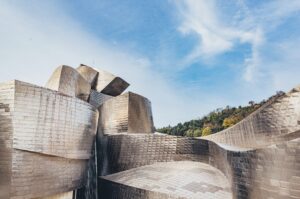
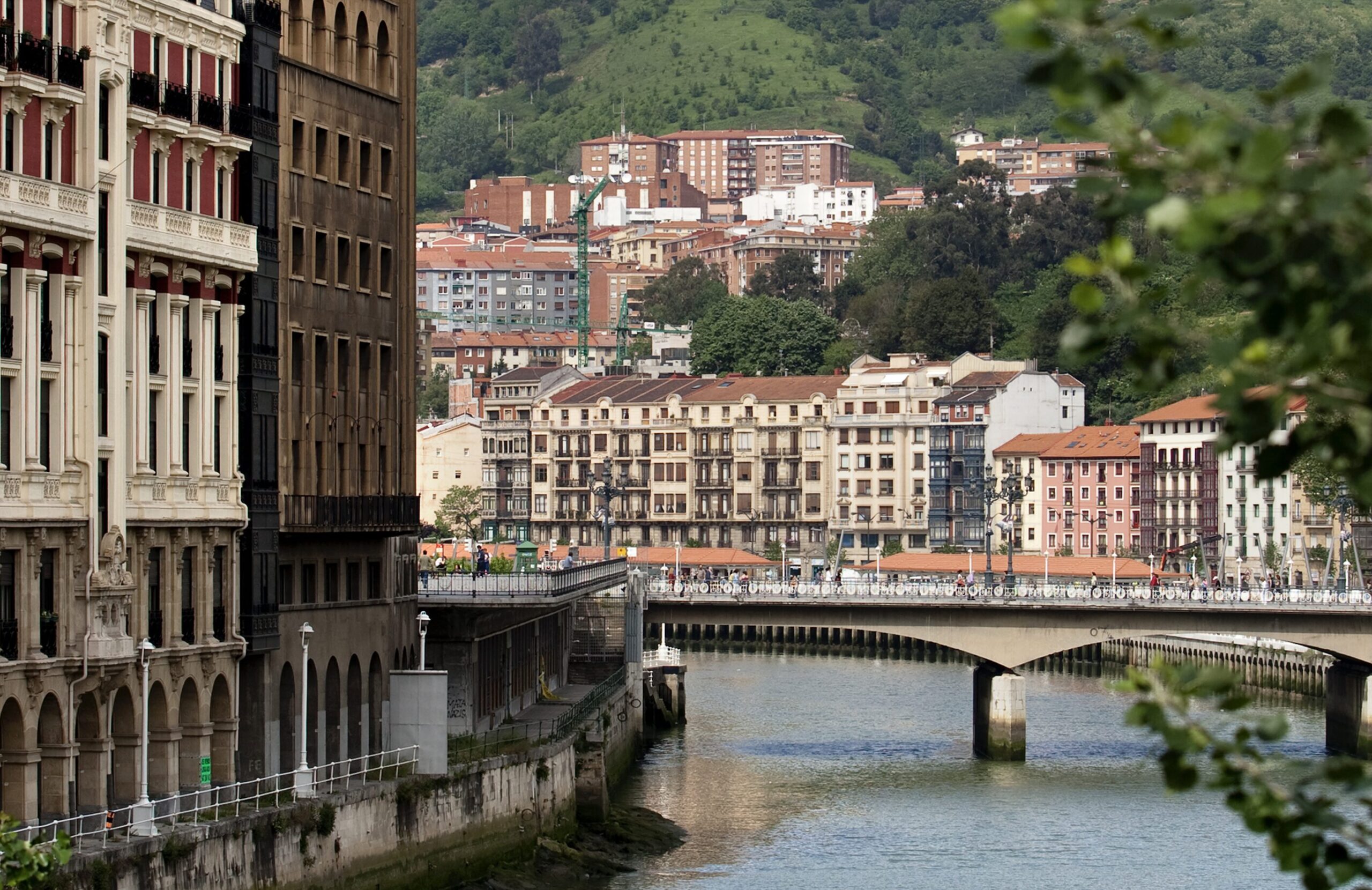
We retake the A-8 highway towards Bilbao until exit 124, where we link up with route N-634 which will take us to the Aguinaga Museum, a treasure trove for car lovers and Mercedes-Benz enthusiasts. It’s only a dozen kilometers along route N-634 from there to Bilbao. The best panoramic view of the city can be seen from the Artxanda Viewpoint, an ideal place to plan your visit. At its feet is the Guggenheim Museum of Bilbao, that beautiful mass of titanium plates, the Euskalduna Palace, recognizable by its Corten steel façade, and the Bilbao Estuary Maritime Museum. We mustn’t forget to sample some pintxos around the old town and to visit the Ribera Market and the Azkuna Zentroa Contemporary Culture Center to discover the city’s varied cultural program.
A route through the Basque Country